 |
Early
Days | 1940s | 1950s | 1960s
Early Days
There are some 300 members of the Bahá'í Faith
in Austin at the time of this writing (September 2003) including
nearly 50 students who are members of the University of Texas
Bahá'í Association. The members of the Faith live
throughout the city of Austin and meet at their administrative
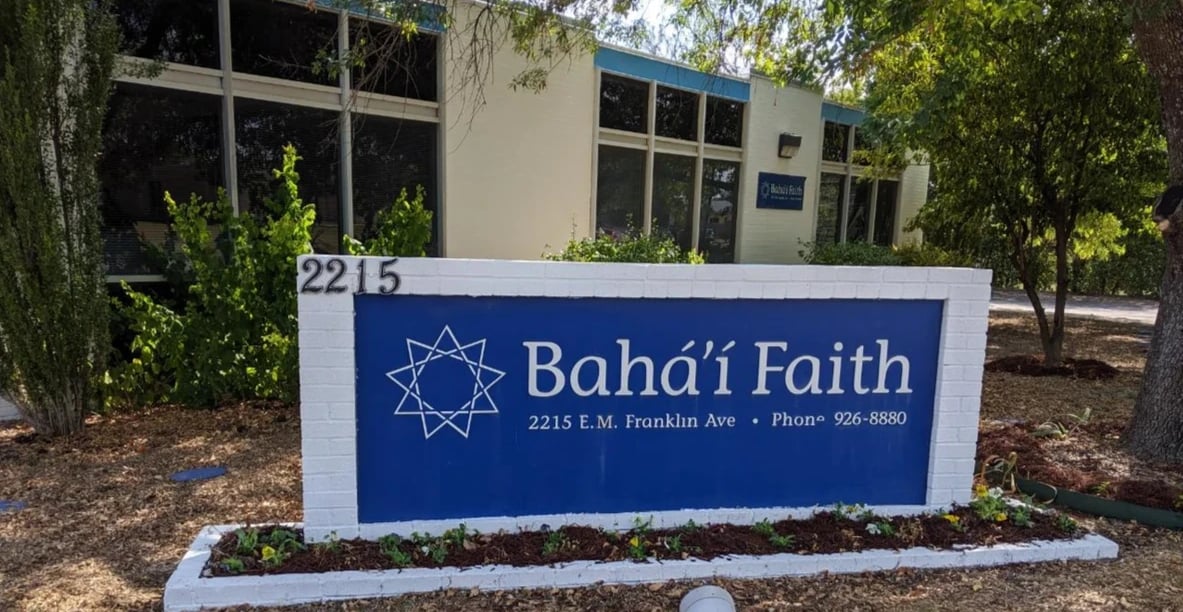
Center at 2215 E. M. Franklin Avenue, where adult study and children's
classes are held on Sunday from 11:00 a.m. to 12:00 noon. These
classes are open to the public but those who are not familiar
with the Bahá'í Faith might wish to attend the
devotional programs held at 10:30 a.m. Sunday to which the public
is most cordially invited. Often the program will consist of
readings of a devotional character not only from the Bahá'í Writings
but from the Old and New Testaments of the Bible, the Bhagavad
Gita, and the Qur'an (Koran).
There are Bahá'ís who live in all of the communities
around Austin many of whom bring their children to the Austin
Center for Sunday classes.
Other regularly scheduled programs for the public are held on
Thursday nights at 7:30 p.m. when various topics are discussed
and questions answered, and on the first Saturday of each month,
8:00 p.m., Expressions: A Night of Rhythm and Rhyme, a program
for poets and those who appreciate poetry. Over thirty study
circles are ongoing within the greater Austin area and information
about them or other activities can be obtained by calling the
Baha’i Center.
Anna Reinke and the Early Years of the Bahá'í Faith
in Austin
[Note: most of the following material up to the 1960’s
is based on the recollection of Catherine Gent from her "notes" written
in 1992.]
It was probably Anna Reinke who brought the Bahá'í Faith
to Austin in 1912 or 1914. Anna, a young lady at the time, visited
her sister in Washington, D.C., about that time. There she heard
the Message of Bahá'u'lláh. the founder of the
Bahá'í Faith. She accepted it forthwith, becoming,
to the best of our knowledge, the first Bahá'í in
Texas. She devoted the rest of her life to teaching the wonderful
Message.
Anna was born to a German immigrant father, Paul Reinke, and
a native Texan mother, Emaline Lohmann, on August 15, 1882, in
Bee Cave, Texas. Her father was a merchant and Anna was one of
six children. Anna was a seamstress in Austin for many years
and lived on Avenue D in Austin. She bought a city streetcar,
probably in the 1940's, and moved it to her property on a hillside
off Highway 71 South, the site of which was then known as Lohmann's
Crossing and now occupied by an Appletree store and shopping
center at the South entrance of Lakeway.
It was a beautiful pastoral setting, in a grove of live oak trees
overlooking the valley to the west. She called it Flintrock.
She was a remarkably resourceful woman who lived alone, had her
own ingenious water system installed, made all her clothes and
her shoes (!), grew her own food, added a fine, comfortable patio
and covered verandah to her "house" and still found
time to correspond with Bahá'ís all over the world.
Her teaching charts and loving letters and laboriously handwritten
pages of long quotations and prayers from the Writings have been
preserved, testimony to her dedication and undying love for Bahá'u'lláh
and His Message.
Anna was eager to share her home with the Bahá'ís
for any Bahá'í activity. Many conferences and picnics
and Holy Day observances were held there in the twenty or more
years she lived at Flint Rock. It was her fond wish to give her
land to the Faith but having grown old and feeble, not marrying,
she exchanged the land for care in a nursing home. While there
for her last few years she never ceased to teach the Faith and
one of her attendants accepted it. She died in the Monte Siesta
Nursing home on Dudmar, near Oak Hill, three months before her
89th birthday, on May 24, 1971, following a massive stroke.
Catherine (better known as Neenah) Smith came to Austin in the 1940’s from
San Antonio, a widow with grown children and grandchildren. She was the only
member of her family to accept the Faith and is described as petite, proper,
always well-dressed, and absolutely indefatigable when came to promotion of the
Faith. Much of the success of the spread of the name of Bahá'í in
Austin belongs to Neenah. She never stopped, taking the bus to East Austin and
making friends with prominent school officials and church officials there. Neither
she nor Anna had a car and neither had much money, but they persevered, putting
stories in the newspaper, holding "firesides" (home meetings) and arranging
public meetings and speakers. Anna moved to the country not many years after
Neenah came.
Neenah would travel to College Station to visit family where Catherine Gent and
her family were at the time, becoming fast friends.
Catherine Gent and family lived in Austin from 1953 until 1955, Other Bahá'ís
who lived in Austin at that time were Henrietta and Herbert Buder and their four
children and Henrietta's father, George Clark, from Colorado (Denver area), an
early Bahá'í pioneer (volunteer teacher) to other countries.
During this period meetings were held in homes and using the hotels (the Stephen
F. Austin and the Driskill) and the old Austin Public Library on Ninth Street,
the meeting room in the basement -- as well as the Howson Branch Library on Bowman
in Tarrytown. Holy Day observances and community meetings were held in homes.
Catherine Gent and George Clark held a weekly series on "Progressive Revelation" in
the Stephen F. Austin Hotel serving coffee and cookies to from ten to twenty-five
guests each week.
The first Bahá'í Association was formed on the University of Texas
in Austin by three or four students and staff in 1966 or '67. A student from
San Antonio, Elizabeth Rodriguez (now Jenkerson), was one of the organizers.
She graduated in Library work and traveled to several European countries teaching
the Bahá'í Faith and currently serves at the Bahá'í World
Center in Haifa, Israel. The Baha’i Association has been active on the
campus for over 35 years and has been recognized by the University for its outstanding
service and range of activities. For more information visit the Baha’i
information table on the West Mall most weekdays during the school year.
As the number of Bahá’ís in Austin increased to the point
they could no longer hold regular meetings in homes, a building was rented on
Duval which served as the local Bahá’í Center. In 1985 the
Bahá’ís purchased a building at 4317 Airport Blvd. which
had been used by the Second Church of Christ Scientists.
Additional Bahá’í communities were established in the Austin
Metropolitan area, some of them by members of the Austin community who moved
to help establish those communities. Today there are Bahá’í communities
in Cedar Park, Round Rock, Pflugerville, Bastrop, San Marcos, Georgetown, Travis
County, and Williamson County.
In 1998 the Bahá’ís of Austin purchased an office building
at 2215 E. M. Franklin Avenue which they converted for use as their Center for
community and public meetings and administrative activities. This building is
about one-half block off Manor Rd. opposite the entrance to the former Robert
Mueller Airport.
|